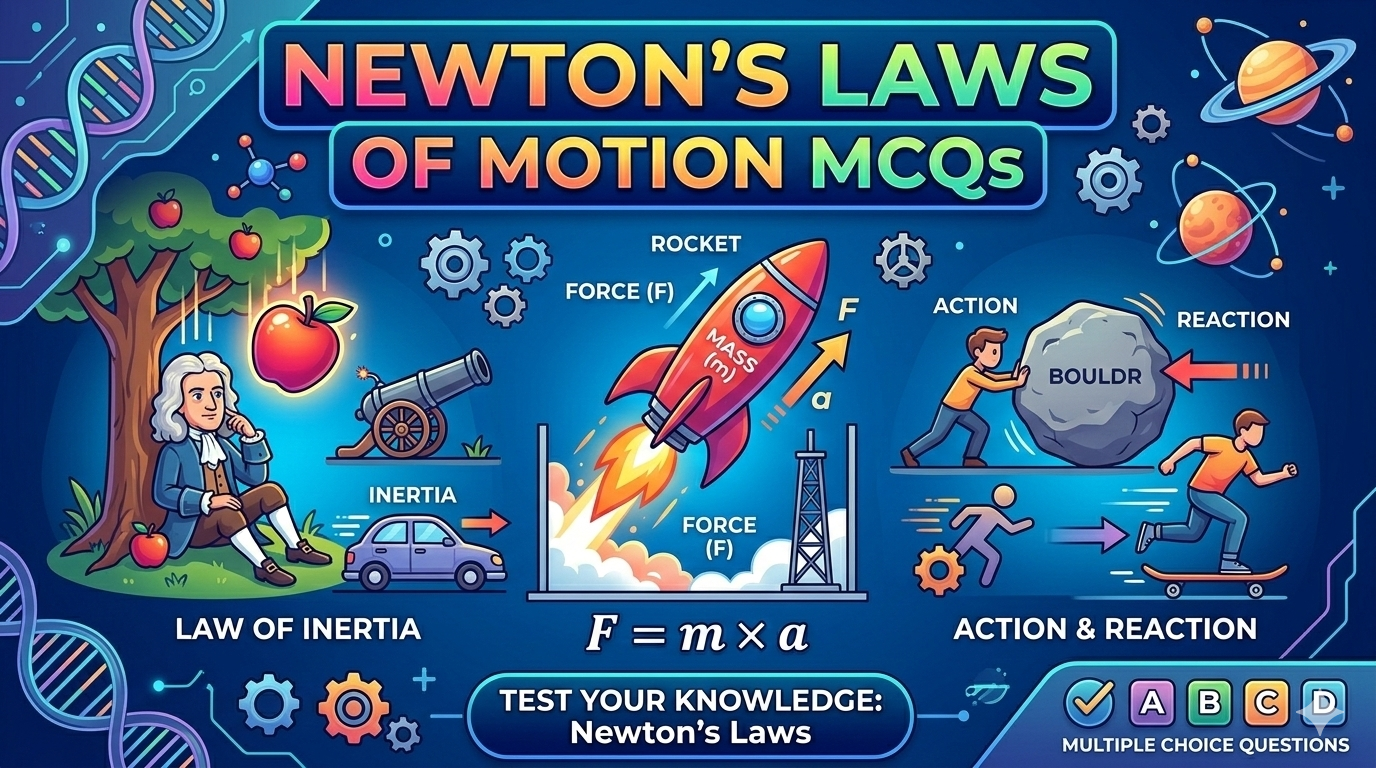
Newton’s Laws of Motion MCQs
Test your understanding of Newton’s three laws of motion with 10 MCQs covering force, inertia, momentum, and action-reaction pairs. Perfect for board exam and entry test preparation.
0 of 10 answered0%
⏱ 15:00
Score: 0/10
Q1
Which law states that an object at rest stays at rest unless acted upon by an external force?
✓ C – Newton’s First Law
Newton’s First Law (Law of Inertia) states that an object remains at rest or in uniform motion unless acted on by a net external force. This property of matter is called inertia.
Newton’s First Law (Law of Inertia) states that an object remains at rest or in uniform motion unless acted on by a net external force. This property of matter is called inertia.
Q2
If a net force of 20 N acts on a 4 kg object, what is its acceleration?
✓ C – 5 m/s²
Using F = ma → a = F/m = 20/4 = 5 m/s². Newton’s Second Law states that force equals mass times acceleration.
Using F = ma → a = F/m = 20/4 = 5 m/s². Newton’s Second Law states that force equals mass times acceleration.
Q3
Newton’s Third Law states that every action has an equal and opposite:
✓ B – Reaction
Newton’s Third Law: For every action there is an equal and opposite reaction. The forces act on different objects — e.g., a rocket expels gas downward (action), gas pushes rocket upward (reaction).
Newton’s Third Law: For every action there is an equal and opposite reaction. The forces act on different objects — e.g., a rocket expels gas downward (action), gas pushes rocket upward (reaction).
Q4
The SI unit of force is:
✓ C – Newton
The SI unit of force is the Newton (N). 1 N = 1 kg·m/s². It is named after Sir Isaac Newton. One Newton is the force needed to accelerate a 1 kg mass at 1 m/s².
The SI unit of force is the Newton (N). 1 N = 1 kg·m/s². It is named after Sir Isaac Newton. One Newton is the force needed to accelerate a 1 kg mass at 1 m/s².
Q5
Inertia of an object depends on its:
✓ C – Mass
Inertia is the resistance to change in motion. It depends on mass — the greater the mass, the greater the inertia. A heavy truck is harder to stop than a bicycle because it has more inertia.
Inertia is the resistance to change in motion. It depends on mass — the greater the mass, the greater the inertia. A heavy truck is harder to stop than a bicycle because it has more inertia.
Q6
A 60 kg person stands on a scale in an elevator accelerating upward at 2 m/s². What does the scale read? (g = 10 m/s²)
✓ C – 720 N
Scale reads N = m(g+a) = 60(10+2) = 720 N. When elevator accelerates upward, apparent weight increases. This is Newton’s Second Law applied to an accelerating reference frame.
Scale reads N = m(g+a) = 60(10+2) = 720 N. When elevator accelerates upward, apparent weight increases. This is Newton’s Second Law applied to an accelerating reference frame.
Q7
When a gun fires a bullet, the gun recoils backward. This is an example of:
✓ C – Newton’s Third Law
Gun recoil is a classic example of Newton’s Third Law. The gun exerts a forward force on the bullet (action); the bullet exerts an equal backward force on the gun (reaction), causing recoil.
Gun recoil is a classic example of Newton’s Third Law. The gun exerts a forward force on the bullet (action); the bullet exerts an equal backward force on the gun (reaction), causing recoil.
Q8
The tendency of a body to resist changes in its state of motion is called:
✓ C – Inertia
Inertia is the tendency of a body to resist changes to its state of rest or uniform motion. It is directly proportional to mass and is the basis of Newton’s First Law.
Inertia is the tendency of a body to resist changes to its state of rest or uniform motion. It is directly proportional to mass and is the basis of Newton’s First Law.
Q9
Two forces of 3 N and 4 N act perpendicularly on an object. The resultant force is:
✓ B – 5 N
For perpendicular forces: F = √(3² + 4²) = √(9+16) = √25 = 5 N. This is a direct application of the Pythagorean theorem to vector addition.
For perpendicular forces: F = √(3² + 4²) = √(9+16) = √25 = 5 N. This is a direct application of the Pythagorean theorem to vector addition.
Q10
Which of the following is a vector quantity?
✓ D – Force
Force is a vector quantity — it has both magnitude and direction. Mass, speed, and temperature are scalar quantities (magnitude only). Vectors follow the laws of vector addition, not simple arithmetic.
Force is a vector quantity — it has both magnitude and direction. Mass, speed, and temperature are scalar quantities (magnitude only). Vectors follow the laws of vector addition, not simple arithmetic.
About These Newton’s Laws MCQs
These Newton’s Laws of Motion MCQs cover all three laws comprehensively — inertia, F=ma, and action-reaction pairs. They are designed for students in Class 9 & 10, FSc, and competitive entry tests.
Each MCQ includes a step-by-step explanation so you understand the ‘why’ behind every answer, not just the correct option.
Topics Covered
- Newton’s First Law – Inertia
- Newton’s Second Law – F = ma
- Newton’s Third Law – Action & Reaction
- Vector vs scalar quantities
- Apparent weight in elevators
- Gun recoil examples
Exam Tips
Focus on numerical problems using F=ma and always identify which law applies to each scenario. Newton’s Third Law questions often involve rockets, guns, and swimming — practice identifying action-reaction pairs.
Frequently Asked Questions
What is Newton’s First Law of Motion? ›
Newton’s First Law (Law of Inertia) states that a body at rest remains at rest, and a body in motion remains in uniform motion in a straight line, unless acted upon by an external net force.
What is the formula for Newton’s Second Law? ›
F = ma, where F is net force (Newtons), m is mass (kg), and a is acceleration (m/s²). This law connects force, mass, and acceleration quantitatively.
Give an example of Newton’s Third Law. ›
A rocket expelling gas downward (action) experiences thrust upward (reaction). Other examples: gun recoil, swimming, walking on the ground.
What is the difference between mass and weight? ›
Mass is the amount of matter in an object (kg) — it never changes. Weight is the gravitational force on that mass (N = mg) and varies with gravitational field strength.
Are these MCQs suitable for MDCAT? ›
Yes. Newton’s Laws are part of the Physics section in MDCAT and ECAT syllabi. Numerical problems and conceptual questions both appear frequently.