Photosynthesis MCQs – Light Reaction, Dark Reaction & Chloroplasts
Master the process of photosynthesis with 10 MCQs covering light-dependent reactions, Calvin cycle, chloroplast structure, pigments, and limiting factors.
0 of 10 answered0%
⏱ 15:00
Score: 0/10
Q1
What is the overall equation for photosynthesis?
✓ B – 6CO₂ + 6H₂O → C₆H₁₂O₆ + 6O₂
The correct equation: 6CO₂ + 6H₂O + light energy → C₆H₁₂O₆ + 6O₂. Photosynthesis converts carbon dioxide and water into glucose (food) and oxygen using sunlight.
The correct equation: 6CO₂ + 6H₂O + light energy → C₆H₁₂O₆ + 6O₂. Photosynthesis converts carbon dioxide and water into glucose (food) and oxygen using sunlight.
Q2
In which organelle does photosynthesis occur?
✓ C – Chloroplast
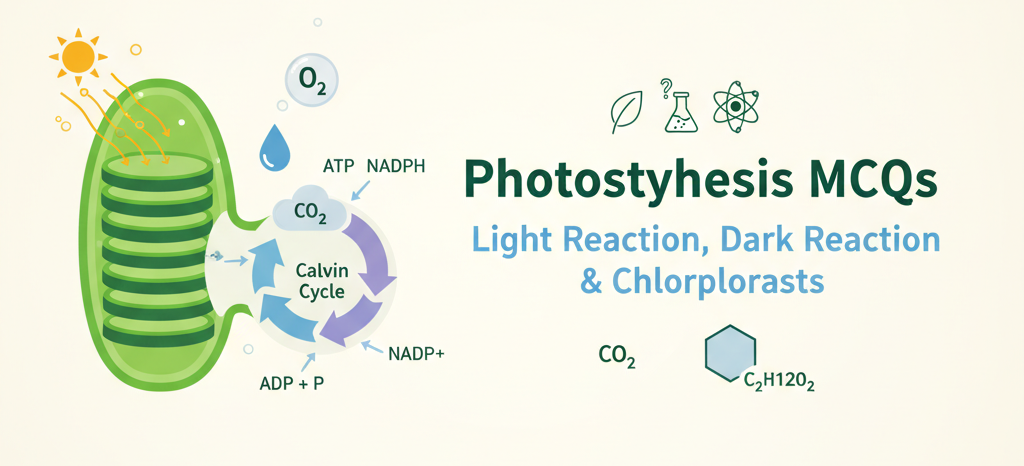
Photosynthesis occurs in the chloroplast. The light reactions take place on the thylakoid membranes, while the Calvin cycle (dark reactions) occurs in the stroma.
Photosynthesis occurs in the chloroplast. The light reactions take place on the thylakoid membranes, while the Calvin cycle (dark reactions) occurs in the stroma.
Q3
The green pigment in chloroplasts responsible for absorbing light is:
✓ C – Chlorophyll
Chlorophyll is the primary photosynthetic pigment. It absorbs red and blue light most effectively and reflects green light (which is why plants appear green). Chlorophyll a and b are the main types.
Chlorophyll is the primary photosynthetic pigment. It absorbs red and blue light most effectively and reflects green light (which is why plants appear green). Chlorophyll a and b are the main types.
Q4
The light-dependent reactions of photosynthesis occur in the:
✓ C – Thylakoid membrane
Light-dependent reactions occur on the thylakoid membranes inside the chloroplast. Here, light energy is used to split water (photolysis), produce ATP, NADPH, and release O₂.
Light-dependent reactions occur on the thylakoid membranes inside the chloroplast. Here, light energy is used to split water (photolysis), produce ATP, NADPH, and release O₂.
Q5
The Calvin cycle (dark reactions) occurs in the:
✓ B – Stroma
The Calvin cycle takes place in the stroma of the chloroplast. It uses ATP and NADPH (from light reactions) to fix CO₂ into glucose through a series of enzyme-controlled reactions.
The Calvin cycle takes place in the stroma of the chloroplast. It uses ATP and NADPH (from light reactions) to fix CO₂ into glucose through a series of enzyme-controlled reactions.
Q6
What gas is released as a by-product of photosynthesis?
✓ D – Oxygen
Oxygen (O₂) is released as a by-product when water molecules are split during the light reactions (photolysis of water). 6H₂O → 12H + 6O₂. This O₂ is released into the atmosphere.
Oxygen (O₂) is released as a by-product when water molecules are split during the light reactions (photolysis of water). 6H₂O → 12H + 6O₂. This O₂ is released into the atmosphere.
Q7
Which of the following is a limiting factor of photosynthesis?
✓ B – Light intensity
Limiting factors of photosynthesis include: light intensity, CO₂ concentration, water availability, and temperature. Increasing a limiting factor will increase the rate of photosynthesis until another factor becomes limiting.
Limiting factors of photosynthesis include: light intensity, CO₂ concentration, water availability, and temperature. Increasing a limiting factor will increase the rate of photosynthesis until another factor becomes limiting.
Q8
The process of splitting water molecules during photosynthesis is called:
✓ B – Photolysis
Photolysis is the splitting of water molecules using light energy: 2H₂O → 4H⁺ + 4e⁻ + O₂. The electrons replace those lost by chlorophyll during the light reactions.
Photolysis is the splitting of water molecules using light energy: 2H₂O → 4H⁺ + 4e⁻ + O₂. The electrons replace those lost by chlorophyll during the light reactions.
Q9
ATP produced during the light reactions is used in:
✓ C – The Calvin cycle
ATP and NADPH produced during light reactions are used in the Calvin cycle (stroma) to fix CO₂ into G3P, which is then used to synthesize glucose. Energy flows from light reactions to dark reactions.
ATP and NADPH produced during light reactions are used in the Calvin cycle (stroma) to fix CO₂ into G3P, which is then used to synthesize glucose. Energy flows from light reactions to dark reactions.
Q10
Which wavelength of light is most absorbed by chlorophyll?
✓ C – Red and Blue
Chlorophyll absorbs red light (~660–700 nm) and blue light (~430–450 nm) most effectively. It reflects green light, which is why plants look green. Red and blue are the most effective wavelengths for photosynthesis.
Chlorophyll absorbs red light (~660–700 nm) and blue light (~430–450 nm) most effectively. It reflects green light, which is why plants look green. Red and blue are the most effective wavelengths for photosynthesis.
About These Photosynthesis MCQs
These Photosynthesis MCQs cover the complete process from light reactions to the Calvin cycle. They are ideal for Class 10, FSc Biology students, and MDCAT candidates.
Photosynthesis is one of the most important and frequently tested topics in biology. These questions build conceptual understanding of each stage.
Topics Covered
- Overall equation of photosynthesis
- Chloroplast structure — thylakoid and stroma
- Light-dependent reactions (Light reactions)
- Calvin cycle (Dark reactions / CO₂ fixation)
- Photolysis of water
- Limiting factors of photosynthesis
MDCAT Focus Areas
MDCAT frequently tests the location of each stage (thylakoid vs stroma), the products of each stage (ATP, NADPH, O₂, glucose), and limiting factors. Understand the flow: Light → ATP/NADPH → Calvin Cycle → Glucose.
Frequently Asked Questions
What is photosynthesis? ›
Photosynthesis is the process by which green plants use sunlight, water, and CO₂ to produce glucose and oxygen: 6CO₂ + 6H₂O + light → C₆H₁₂O₆ + 6O₂.
What is the difference between light and dark reactions? ›
Light reactions occur on thylakoid membranes and produce ATP, NADPH, and O₂. Dark reactions (Calvin cycle) occur in the stroma and use ATP/NADPH to fix CO₂ into glucose.
What is photolysis? ›
Photolysis is the light-driven splitting of water: 2H₂O → 4H⁺ + 4e⁻ + O₂. The oxygen released during photosynthesis comes from water, not CO₂.
Why do plants appear green? ›
Chlorophyll absorbs red and blue light but reflects green light. Since green light is reflected back to our eyes, plants appear green.
What are limiting factors of photosynthesis? ›
Light intensity, CO₂ concentration, water availability, and temperature. Increasing any limiting factor boosts photosynthesis rate — until a different factor becomes the new bottleneck.