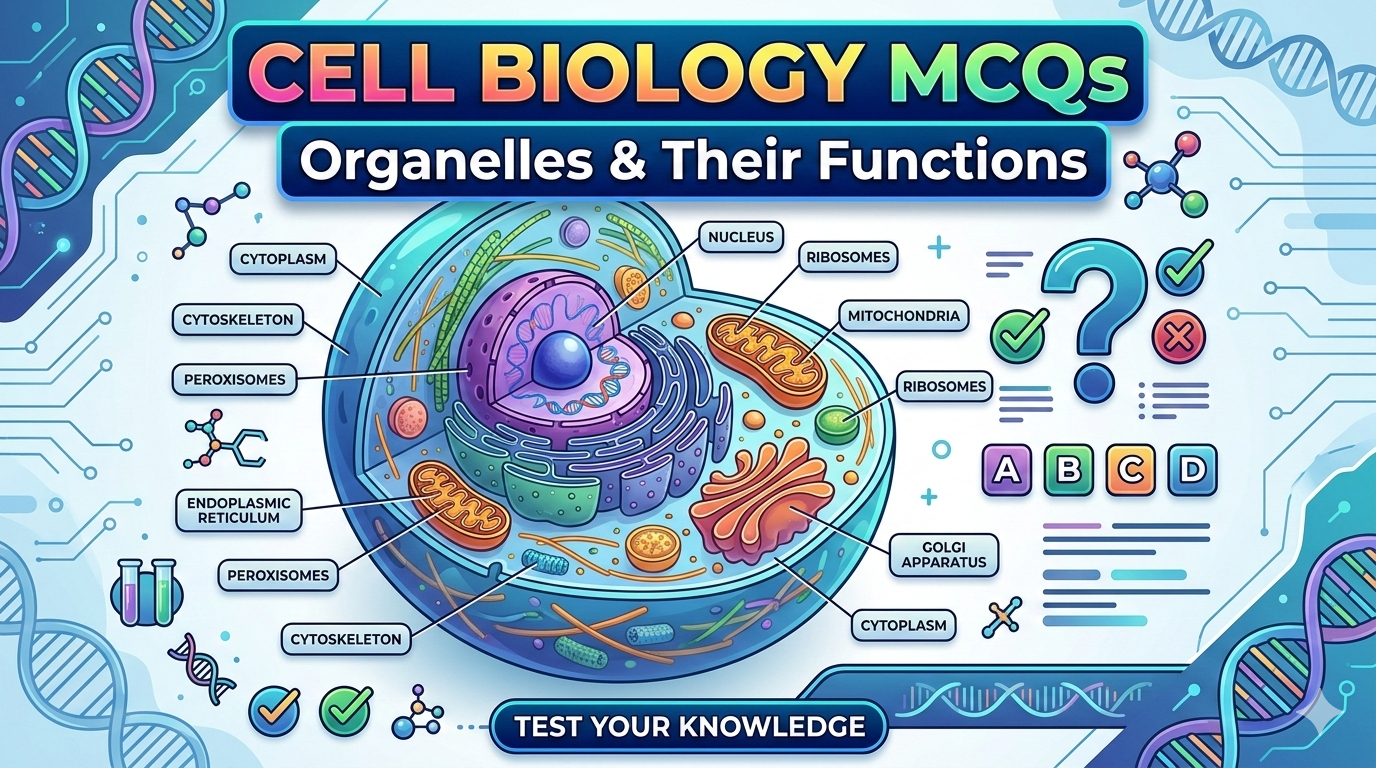
Cell Biology MCQs – Organelles & Their Functions
Test your knowledge of cell organelles with 10 carefully curated MCQs. Covers mitochondria, nucleus, ribosomes, Golgi apparatus, lysosomes, and more — with full answer explanations.
0 of 10 answered
0%
⏱ 15:00
Score: 0/10
Q1
What is the primary function of the mitochondria in a cell?
✓ B – ATP production
Mitochondria are the “powerhouse of the cell.” They produce ATP through cellular respiration (oxidative phosphorylation), converting glucose and oxygen into energy, CO₂, and water.
Mitochondria are the “powerhouse of the cell.” They produce ATP through cellular respiration (oxidative phosphorylation), converting glucose and oxygen into energy, CO₂, and water.
Q2
Which organelle contains the genetic material (DNA) and controls all cell activities?
✓ C – Nucleus
The nucleus is the control center of the cell. It contains DNA organized into chromosomes and directs metabolism, protein synthesis, and reproduction. It is enclosed in a double-membrane nuclear envelope.
The nucleus is the control center of the cell. It contains DNA organized into chromosomes and directs metabolism, protein synthesis, and reproduction. It is enclosed in a double-membrane nuclear envelope.
Q3
Where does protein synthesis (translation) occur in the cell?
✓ A – Ribosomes
Ribosomes read mRNA and assemble amino acids into polypeptide chains. They can be free-floating in the cytoplasm or attached to the rough endoplasmic reticulum (RER).
Ribosomes read mRNA and assemble amino acids into polypeptide chains. They can be free-floating in the cytoplasm or attached to the rough endoplasmic reticulum (RER).
Q4
The Golgi apparatus is often called the cell’s “post office” because it:
✓ B – Modifies, sorts & packages proteins
The Golgi apparatus receives proteins from the ER, modifies and sorts them, then packages them into vesicles for transport to their final destination inside or outside the cell.
The Golgi apparatus receives proteins from the ER, modifies and sorts them, then packages them into vesicles for transport to their final destination inside or outside the cell.
Q5
Which organelle contains digestive enzymes and breaks down cellular waste?
✓ C – Lysosome
Lysosomes contain hydrolytic enzymes that break down worn-out organelles, food particles, and foreign invaders. They maintain an acidic environment (~pH 4.5–5) for enzyme activity.
Lysosomes contain hydrolytic enzymes that break down worn-out organelles, food particles, and foreign invaders. They maintain an acidic environment (~pH 4.5–5) for enzyme activity.
Q6
Which structure is present in plant cells but absent in animal cells?
✓ C – Cell wall
Plant cells have a rigid cell wall made of cellulose that provides structure and protection. Animal cells only have a flexible cell membrane. Plants also uniquely have chloroplasts and a large central vacuole.
Plant cells have a rigid cell wall made of cellulose that provides structure and protection. Animal cells only have a flexible cell membrane. Plants also uniquely have chloroplasts and a large central vacuole.
Q7
The endoplasmic reticulum studded with ribosomes on its surface is called:
✓ A – Rough ER
Rough ER is studded with ribosomes and involved in protein synthesis and transport. Smooth ER lacks ribosomes and handles lipid synthesis and detoxification.
Rough ER is studded with ribosomes and involved in protein synthesis and transport. Smooth ER lacks ribosomes and handles lipid synthesis and detoxification.
Q8
Chloroplasts in plant cells are responsible for:
✓ B – Photosynthesis
Chloroplasts contain chlorophyll and convert sunlight, CO₂, and water into glucose and oxygen. Like mitochondria, they have their own DNA and a double membrane.
Chloroplasts contain chlorophyll and convert sunlight, CO₂, and water into glucose and oxygen. Like mitochondria, they have their own DNA and a double membrane.
Q9
What is the main function of the cell membrane?
✓ C – Selective permeability control
The cell membrane is a phospholipid bilayer that controls what enters and exits the cell, maintaining homeostasis by regulating ions, nutrients, and waste.
The cell membrane is a phospholipid bilayer that controls what enters and exits the cell, maintaining homeostasis by regulating ions, nutrients, and waste.
Q10
Which organelle is called the “suicidal bag” because its enzymes can destroy the cell itself?
✓ D – Lysosome
If a lysosome ruptures inside the cell, its digestive enzymes can destroy the entire cell — this process is called autolysis. Controlled cell self-destruction is known as apoptosis, which is vital in development and immunity.
If a lysosome ruptures inside the cell, its digestive enzymes can destroy the entire cell — this process is called autolysis. Controlled cell self-destruction is known as apoptosis, which is vital in development and immunity.
About These Cell Biology MCQs
This set of Cell Biology Multiple Choice Questions (MCQs) covers the fundamental organelles found in animal and plant cells. Ideal for students preparing for Matric (Class 9 & 10), FSc, MDCAT, ECAT, and other competitive exams.
Each question includes a detailed explanation to build deeper understanding rather than rote memorization.
Topics Covered
- Mitochondria — ATP production & cellular respiration
- Nucleus — genetic control & DNA storage
- Ribosomes — protein synthesis & translation
- Golgi Apparatus — packaging & secretion
- Lysosomes — digestion & autolysis
- Rough & Smooth Endoplasmic Reticulum
- Chloroplasts — photosynthesis in plant cells
- Plant vs. animal cell differences
Exam Relevance
Cell biology is a high-weightage topic in MDCAT, ECAT, and Board exams. These MCQs are aligned with the Punjab & Federal Board syllabus and PMDC guidelines for medical entry tests.
Frequently Asked Questions
What is the powerhouse of the cell? ›
The mitochondria is called the powerhouse of the cell. It produces ATP through cellular respiration, which is the primary energy currency used by the cell for all its functions.
What is the difference between rough and smooth ER? ›
Rough ER has ribosomes on its surface and is involved in protein synthesis and transport. Smooth ER lacks ribosomes and handles lipid synthesis, detoxification, and calcium ion storage.
Which organelles are only in plant cells? ›
Plant cells uniquely contain: (1) a cellulose cell wall, (2) chloroplasts for photosynthesis, and (3) a large central vacuole for turgor pressure. Animal cells have none of these structures.
Why is the lysosome called the suicidal bag? ›
Lysosomes contain powerful hydrolytic enzymes. If the membrane ruptures, these enzymes digest the entire cell — a process called autolysis. Controlled cell death triggered by lysosomes is called apoptosis.
Are these MCQs suitable for MDCAT preparation? ›
Yes! These questions are aligned with the MDCAT and ECAT syllabi. Cell organelle questions appear frequently in these exams, and the explanations here help reinforce conceptual understanding required at that level.