Chemical Bonding MCQs – Ionic, Covalent & Metallic Bonds
Practice 10 MCQs on chemical bonding covering ionic bonds, covalent bonds, metallic bonds, Lewis structures, polarity, and bond properties.
0 of 10 answered0%
⏱ 18:00
Score: 0/10
Q1
An ionic bond is formed by the:
✓ B – Transfer of electrons
Ionic bonds form when one atom transfers electrons to another, creating oppositely charged ions (cation + anion) that attract each other. Example: NaCl — Na gives 1e⁻ to Cl.
Ionic bonds form when one atom transfers electrons to another, creating oppositely charged ions (cation + anion) that attract each other. Example: NaCl — Na gives 1e⁻ to Cl.
Q2
Which type of bond is formed between two non-metal atoms?
✓ C – Covalent bond
Covalent bonds form when two non-metal atoms share electrons. Both atoms achieve a stable electron configuration. Examples: H₂, H₂O, CO₂, CH₄. Ionic bonds form between metals and non-metals.
Covalent bonds form when two non-metal atoms share electrons. Both atoms achieve a stable electron configuration. Examples: H₂, H₂O, CO₂, CH₄. Ionic bonds form between metals and non-metals.
Q3
NaCl (common salt) is an example of:
✓ C – Ionic compound
NaCl is an ionic compound. Sodium (metal) loses 1 electron to become Na⁺; Chlorine (non-metal) gains it to become Cl⁻. The electrostatic attraction between Na⁺ and Cl⁻ is the ionic bond.
NaCl is an ionic compound. Sodium (metal) loses 1 electron to become Na⁺; Chlorine (non-metal) gains it to become Cl⁻. The electrostatic attraction between Na⁺ and Cl⁻ is the ionic bond.
Q4
A double bond consists of how many shared electron pairs?
✓ B – 2
A double bond consists of 2 shared electron pairs (4 electrons total). Single bond = 1 pair (2e⁻), double = 2 pairs (4e⁻), triple = 3 pairs (6e⁻). Example: O₂ has a double bond (O=O).
A double bond consists of 2 shared electron pairs (4 electrons total). Single bond = 1 pair (2e⁻), double = 2 pairs (4e⁻), triple = 3 pairs (6e⁻). Example: O₂ has a double bond (O=O).
Q5
Which of the following molecules has a triple bond?
✓ C – N₂
N₂ (nitrogen gas) has a triple bond (N≡N) — 3 shared electron pairs. This makes N₂ very stable and unreactive. Triple bonds are shorter and stronger than single or double bonds.
N₂ (nitrogen gas) has a triple bond (N≡N) — 3 shared electron pairs. This makes N₂ very stable and unreactive. Triple bonds are shorter and stronger than single or double bonds.
Q6
Electronegativity difference determines bond polarity. A bond is considered ionic if the difference is greater than:
✓ C – 1.7
If electronegativity difference > 1.7, the bond is considered ionic (electron transfer). If 0.4–1.7, it’s polar covalent. If < 0.4, it's nonpolar covalent. This is Pauling's guideline.
If electronegativity difference > 1.7, the bond is considered ionic (electron transfer). If 0.4–1.7, it’s polar covalent. If < 0.4, it's nonpolar covalent. This is Pauling's guideline.
Q7
What is the shape of a water molecule (H₂O)?
✓ C – Bent/V-shaped
H₂O has a bent/V-shape due to 2 bonding pairs and 2 lone pairs on oxygen. Lone pairs repel more than bonding pairs, pushing the H-O-H angle from 109.5° to 104.5°. This is explained by VSEPR theory.
H₂O has a bent/V-shape due to 2 bonding pairs and 2 lone pairs on oxygen. Lone pairs repel more than bonding pairs, pushing the H-O-H angle from 109.5° to 104.5°. This is explained by VSEPR theory.
Q8
Metallic bonds exist between:
✓ C – Metal atoms in a lattice
Metallic bonds exist between metal atoms in a lattice. Valence electrons are delocalized — they form an ‘electron sea’ surrounding positive metal ions. This explains conductivity, malleability, and luster.
Metallic bonds exist between metal atoms in a lattice. Valence electrons are delocalized — they form an ‘electron sea’ surrounding positive metal ions. This explains conductivity, malleability, and luster.
Q9
Which type of bond has the highest bond energy?
✓ C – Triple bond
Triple bonds have the highest bond energy (strongest) and shortest bond length. Bond energy order: Triple > Double > Single. More electron pairs mean stronger attraction and more energy needed to break the bond.
Triple bonds have the highest bond energy (strongest) and shortest bond length. Bond energy order: Triple > Double > Single. More electron pairs mean stronger attraction and more energy needed to break the bond.
Q10
A polar covalent bond forms when:
✓ C – Electrons are unequally shared
Polar covalent bonds form when electrons are unequally shared due to a difference in electronegativity between atoms. The more electronegative atom gets a partial negative charge (δ⁻). Example: H-Cl, H-O.
Polar covalent bonds form when electrons are unequally shared due to a difference in electronegativity between atoms. The more electronegative atom gets a partial negative charge (δ⁻). Example: H-Cl, H-O.
About These Chemical Bonding MCQs
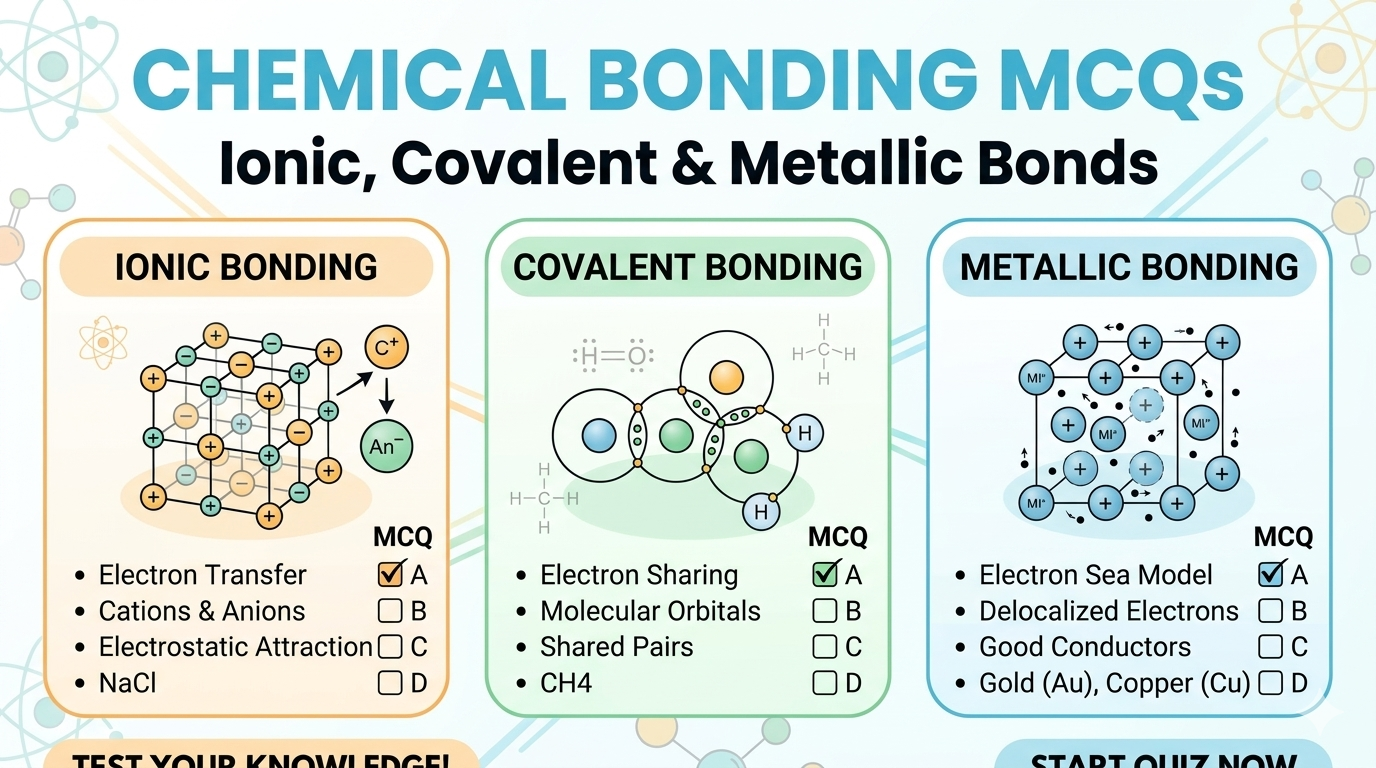
These Chemical Bonding MCQs cover ionic, covalent, and metallic bonds with questions on electronegativity, bond polarity, molecular shapes, and Lewis structures.
Chemical bonding is a core FSc and MDCAT Chemistry topic. Understanding why and how atoms bond is fundamental to all of chemistry.
Topics Covered
- Ionic bonding — electron transfer
- Covalent bonding — electron sharing
- Single, double, and triple bonds
- Polar vs nonpolar covalent bonds
- Molecular geometry (VSEPR theory)
- Metallic bonding and electron sea model
MDCAT Preparation Focus
Know the electronegativity difference thresholds (ionic > 1.7, polar covalent 0.4–1.7, nonpolar < 0.4). Practice drawing Lewis dot structures and applying VSEPR theory to predict molecular shapes.
Frequently Asked Questions
What is the difference between ionic and covalent bonds? ›
Ionic bonds form by electron transfer between metal and non-metal, creating ions. Covalent bonds form by electron sharing between non-metals. Ionic compounds have high melting points; covalent compounds are generally low.
What is a polar covalent bond? ›
A polar covalent bond forms when electrons are shared unequally due to electronegativity differences. The more electronegative atom carries a partial negative charge (δ⁻). Example: H-Cl, H-O in water.
Why does water have a bent shape? ›
Water (H₂O) has a bent shape due to 2 lone pairs on oxygen that repel the bonding pairs, reducing the bond angle from 109.5° to 104.5°. This is predicted by VSEPR theory.
What is metallic bonding? ›
Metallic bonds form between metal atoms where valence electrons are delocalized throughout the lattice (electron sea model). This explains why metals conduct electricity and heat.
Why is N₂ so unreactive? ›
N₂ has a triple bond (N≡N) with very high bond energy (~945 kJ/mol). Breaking this triple bond requires enormous energy, making N₂ extremely stable and unreactive under normal conditions.