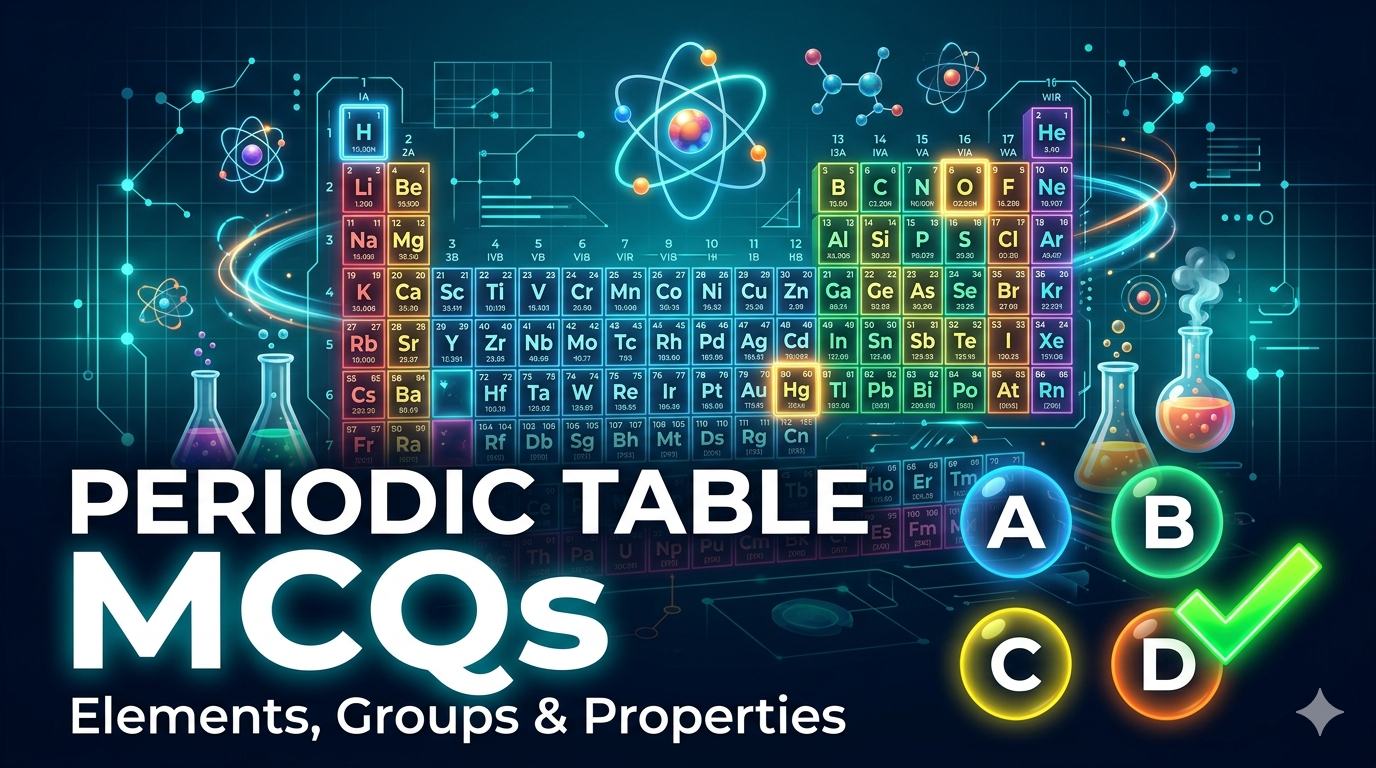
Periodic Table MCQs – Elements, Groups & Properties
Practice 10 key MCQs on the Periodic Table covering periods, groups, alkali metals, halogens, noble gases, atomic number, and periodic trends. Ideal for board exams and entry tests.
0 of 10 answered0%
⏱ 12:00
Score: 0/10
Q1
How many periods are there in the modern Periodic Table?
✓ C – 7
The modern Periodic Table has 7 periods (horizontal rows). Period 1 has 2 elements, periods 2 and 3 have 8 each, periods 4 and 5 have 18 each, and periods 6 and 7 have 32 each.
The modern Periodic Table has 7 periods (horizontal rows). Period 1 has 2 elements, periods 2 and 3 have 8 each, periods 4 and 5 have 18 each, and periods 6 and 7 have 32 each.
Q2
Elements in the same group of the Periodic Table have the same number of:
✓ C – Valence electrons
Elements in the same group (vertical column) have the same number of valence electrons, which gives them similar chemical properties. E.g., all alkali metals (Group 1) have 1 valence electron.
Elements in the same group (vertical column) have the same number of valence electrons, which gives them similar chemical properties. E.g., all alkali metals (Group 1) have 1 valence electron.
Q3
Which group contains the Noble Gases?
✓ D – Group 18
Noble gases (He, Ne, Ar, Kr, Xe, Rn) are in Group 18 (also called Group 0 in older notation). They have a full outer electron shell, making them chemically unreactive (inert).
Noble gases (He, Ne, Ar, Kr, Xe, Rn) are in Group 18 (also called Group 0 in older notation). They have a full outer electron shell, making them chemically unreactive (inert).
Q4
The element with atomic number 11 is:
✓ B – Sodium
Sodium (Na) has atomic number 11 — meaning 11 protons. It is in Period 3, Group 1 (alkali metals). Its electron configuration is 2,8,1.
Sodium (Na) has atomic number 11 — meaning 11 protons. It is in Period 3, Group 1 (alkali metals). Its electron configuration is 2,8,1.
Q5
Halogens are found in which group?
✓ D – Group 17
Halogens (F, Cl, Br, I, At) are in Group 17. They have 7 valence electrons and readily gain 1 electron to form -1 ions (halides). They are highly reactive non-metals.
Halogens (F, Cl, Br, I, At) are in Group 17. They have 7 valence electrons and readily gain 1 electron to form -1 ions (halides). They are highly reactive non-metals.
Q6
As you move across a period from left to right, atomic size generally:
✓ B – Decreases
Across a period, the number of protons increases while electrons are added to the same shell. Increased nuclear charge pulls electrons closer, so atomic radius decreases from left to right.
Across a period, the number of protons increases while electrons are added to the same shell. Increased nuclear charge pulls electrons closer, so atomic radius decreases from left to right.
Q7
Which of the following is an alkali metal?
✓ C – Potassium
Potassium (K) is in Group 1 — the alkali metals. Alkali metals have 1 valence electron, are soft, highly reactive, and react vigorously with water to produce hydroxides and hydrogen gas.
Potassium (K) is in Group 1 — the alkali metals. Alkali metals have 1 valence electron, are soft, highly reactive, and react vigorously with water to produce hydroxides and hydrogen gas.
Q8
The horizontal rows in the Periodic Table are called:
✓ C – Periods
Horizontal rows are called Periods and vertical columns are called Groups (or Families). The period number indicates the number of electron shells in an atom of that element.
Horizontal rows are called Periods and vertical columns are called Groups (or Families). The period number indicates the number of electron shells in an atom of that element.
Q9
Atomic number of an element represents the number of:
✓ B – Protons
Atomic number = number of protons in the nucleus. In a neutral atom, it also equals the number of electrons. It uniquely identifies each element and determines its position in the Periodic Table.
Atomic number = number of protons in the nucleus. In a neutral atom, it also equals the number of electrons. It uniquely identifies each element and determines its position in the Periodic Table.
Q10
Which element has the highest electronegativity?
✓ C – Fluorine
Fluorine (F) has the highest electronegativity (3.98 on Pauling scale). Electronegativity generally increases across a period and decreases down a group. Fluorine is in Period 2, Group 17 — top-right of the table.
Fluorine (F) has the highest electronegativity (3.98 on Pauling scale). Electronegativity generally increases across a period and decreases down a group. Fluorine is in Period 2, Group 17 — top-right of the table.
About These Periodic Table MCQs
These Periodic Table MCQs cover the structure, trends, and element groups in the modern Periodic Table. Questions are aligned with Class 9 & 10 Chemistry and FSc board syllabi.
Understanding periodic trends like atomic radius, ionization energy, and electronegativity is essential for chemistry board exams and competitive tests like MDCAT.
Topics Covered
- Periods and groups structure
- Alkali metals — Group 1
- Halogens — Group 17
- Noble gases — Group 18
- Periodic trends: atomic size, electronegativity
- Atomic number vs mass number
How to Remember the Periodic Table
Focus on learning the first 20 elements in order (H, He, Li, Be, B, C, N, O, F, Ne…) and understand the trends rather than memorizing every element. Most MCQs test trends, groups, and properties — not raw memorization.
Frequently Asked Questions
What is the difference between a period and a group? ›
A period is a horizontal row in the Periodic Table; elements in the same period have the same number of electron shells. A group is a vertical column; elements share the same number of valence electrons.
Why are noble gases unreactive? ›
Noble gases have a complete outer electron shell (2 electrons for He, 8 for others), which makes them extremely stable and chemically inert under normal conditions.
What are alkali metals? ›
Alkali metals are Group 1 elements (Li, Na, K, Rb, Cs, Fr). They have 1 valence electron, are highly reactive, and react with water to produce hydroxides and hydrogen gas.
What is electronegativity? ›
Electronegativity is the tendency of an atom to attract bonding electrons. It increases across a period and decreases down a group. Fluorine has the highest value (3.98).
Are these MCQs good for FSc Chemistry? ›
Yes, these questions are directly aligned with the FSc Chemistry syllabus and cover high-frequency exam topics from the Periodic Table chapter.